Natural Ability Tracking - The Release
By Terry Petro
In my 20+ years of experience in NAVHDA testing, both handling dogs and judging
them, I feel that the tracking release is where more prizes are lost than in any
other area of the Natural Ability Test. What the handler does with the dog before
the track begins can greatly affect the dog's performance in the track once released.
Concentration: Getting the dog to concentrate on the track is the name
of the game here. The dog that can focus on the track is a dog that can overcome
a poor nose, bad scenting conditions, a bird that makes several jumps at the start,
or a myriad of other excuses for a low score in the track. And you can greatly
affect the level of concentration of the dog by what you do before, during and
after the release.
Composure: Keep the dog calm! A good track starts long before you and your
dog reach the feather pile at the start. Be to the holding area long before your
time. Go off by yourself and relax (as best you can). Sit with the dog and just
mellow a bit. Make him lie down and stay quiet. Believe it or not, your dog will
key off of your control. If you make him lie down, stay quiet, he will (it may
take some time, but be persistent). If you plan to use a lead for the start, be
sure you have it with you. When the Judges call you up, take your time, don't
jump up and hurry over. Walk to the Judges with the dog on heel and under control.
Don't lose this control! Don't be in a hurry, and keep the excitement or anticipation
to a minimum. Now is not the time to let him get keyed up and out of control.
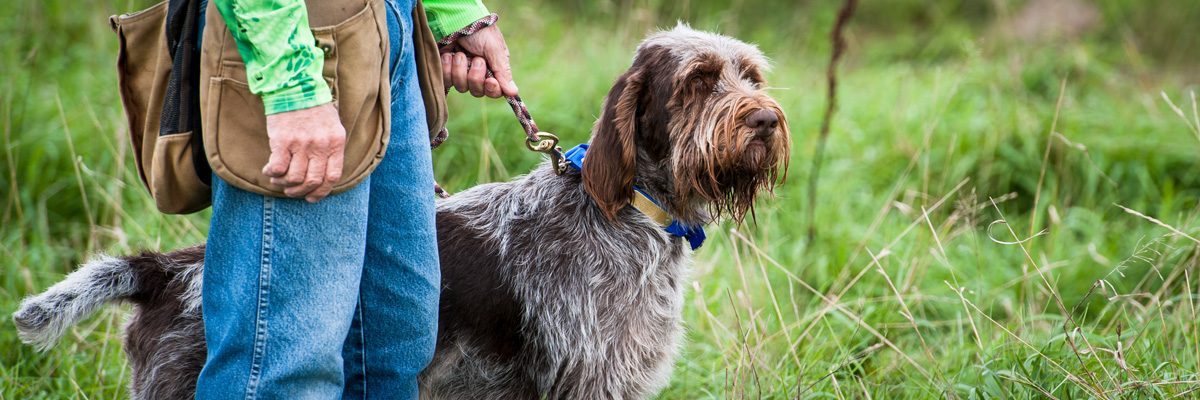
When you reach the Judges, keep the dog under control. Keep him on heel, whoa
or down.
Game Plan: Listen to what the Judges tell you. They will tell you the direction
of the track, where the feather pile is, any hops or jumps the bird made, and
any other information that they feel you should know. Use that information to
your advantage. Note the direction of the wind. Make a plan on how you will start
the dog.
Slip Lead: Many handlers use a slip lead to start the dog. Thought is that
it allows the dog a bit more freedom in following the start of the track than
if you hold on to the dog directly. Make sure that it is going to help more than
hurt. Practice the use of the slip lead long before the test. Keep the lead short.
Too much length and the dog will get tangled and you lose control. A lead with
a loop or knot will not slip through the collar smoothly, and will break the dog's
concentration when it hits the end. I have seen the tag end of the lead whip around
and snap the dog on its head! I can't count high enough to tell you how many times
I watched a dog released with the lead still hanging on the dog's collar! What
do I do? I hold on to the dog's collar, and simply let go when it is time. I prefer
to keep as much control of the dog as possible, and simple is always better for
me
The Release: Don't be in a hurry; this is not a timed event. I have yet
to see a group of Judges tell a handler to hurry-up and release the dog at the
track. Keep the dog calm and under control. Walk to the Judges with the dog at
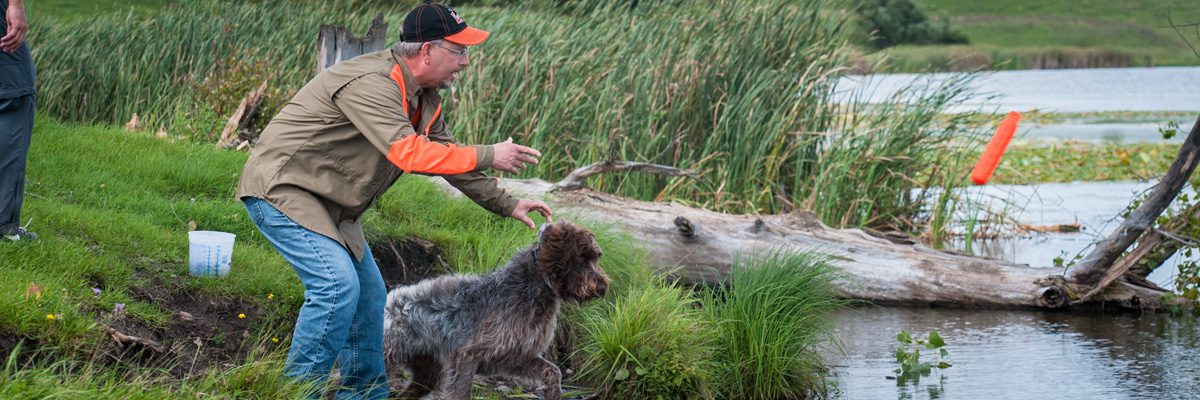
heel. Let the dog smell the feather pile until he is done. Put your hand in the
grass on the track or slightly downwind from the track. Rub your fingers together
to draw the dogs' interest down to where the scent is strongest. When the dog
shows interest, start working down the track as the Judges described. Watch the
dog! If the dog shows interest and focus on the track, great. If he is up and
looking off across the field, if his interest is in search, then now is not the
time to release him. Heel him around, back to the start and the feather pile.
Let him smell the feathers and attract him down to the track scent again with
your fingers. Once he is thinking "track" again, start moving him forward, drawing
him along with your fingers in the grass. When he is concentrating on the track
and moving forward on his own, drawn by the scent of the track, release him. You
may have to work him on the start several times until he is ready to track on
his own. The last dog I tested, an English Pointer female, took four loops at
the start before she was really into it and focused on the track.
The Command: This is optional. You don't really need one with a natural
ability dog, but many handlers use one. I use "dead bird", but other commands
include "fetch", "track", etc. This can help you to put focus on the dog if it
is only used in a tracking situation. But the most important point in using a
command is that it does not divert the dog's attention away from the task at hand.
Don't go through all of the trouble getting the dog started well, only to ruin
the dogs' focus by yelling, "Fetch!" If you use a command, keep it in a low, soothing
tone, and use it often during the start process to indicate to the dog why we
are here.
After the Release: Once you have let the dog go, your job is done. Follow
the instructions given by the Judge. Don't give any more instructions to the dog
unless instructed to by the Judge. All you can do to help is stand upright and
attentively in the direction of the track to give the dog an indication of what
direction he should be working.
Practice: The test should not be the first time you and your dog has been
in this situation. Ideally, you have done this several times in different locations
with different birds. Few dogs can execute a good track the first time totally
from natural abilities. I start my dogs at seven weeks of age using a fishing
rod, line and pieces of hot dogs. We then progress to pigeons, ducks, chukars
and pheasants. Every time we do a track, we go through the same process: the feather
pile, the hand in the grass attracting attention, the same equipment, and the
same command. Also do whatever possible to ensure that the dog is successful.
This way the dog is familiar with the process. When you go to the test, the area
may be different, but the process is the same, and the dog knows what to do.